Capital Gains When Selling Mexican Property
Most foreign owners of Mexican property first think seriously about capital gains tax when a buyer is already at the

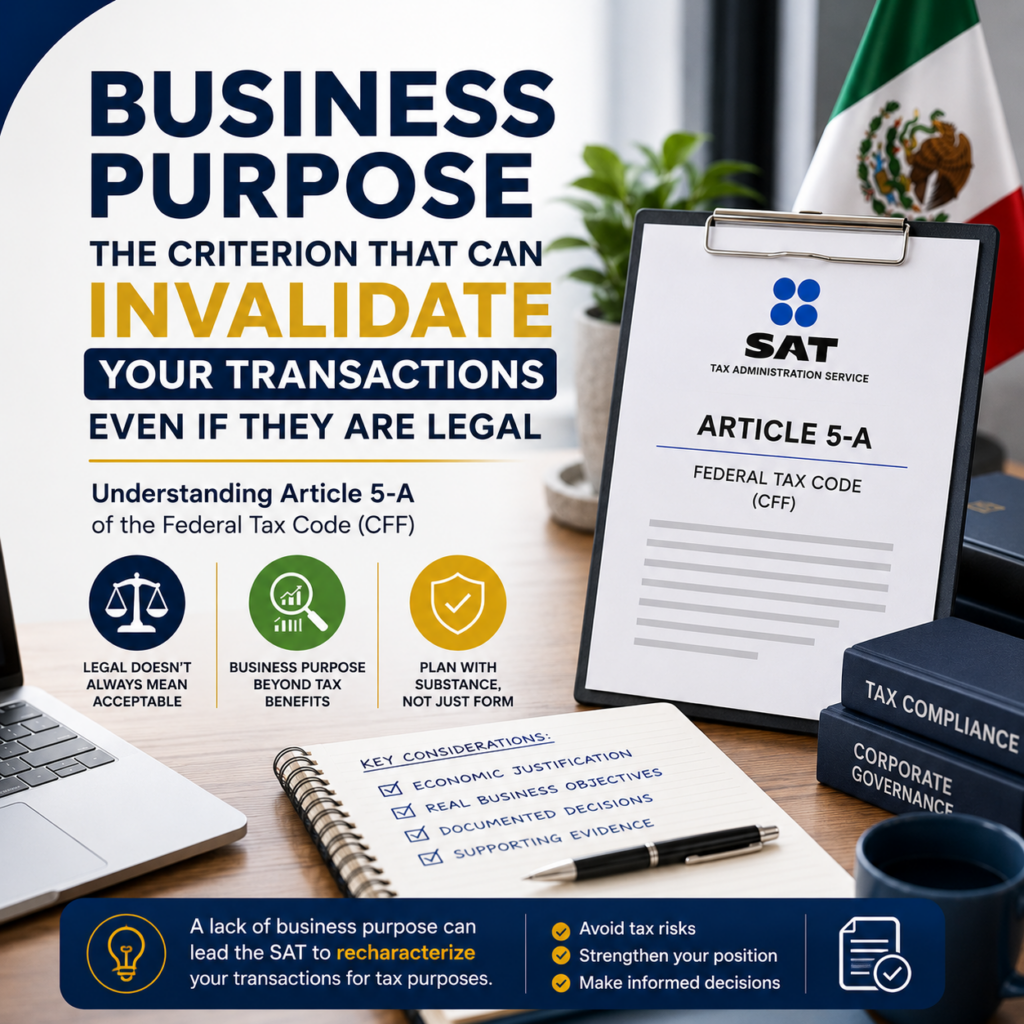
The SAT may recharacterize legally valid transactions if they lack a legitimate business purpose. Learn what Article 5-A of the Federal Tax Code requires and how to protect your corporate restructurings.
Article 5-A of the Mexican Federal Tax Code (Código Fiscal de la Federación – CFF) introduced a significant authority that many businesses underestimate: the Mexican Tax Administration Service (SAT) may recharacterize otherwise lawful transactions for tax purposes if it determines they lack a legitimate business purpose.
In other words, the mere legal validity of a transaction is no longer sufficient to ensure that it will withstand scrutiny by the Mexican tax authorities.
For companies undertaking corporate restructurings, mergers, or spin-offs—transactions that often generate legitimate tax efficiencies—understanding this standard is essential to prevent a well-planned structure from being challenged years later.
A business purpose exists when a transaction is expected to generate a reasonable economic benefit that is separate from and in addition to any tax benefit it may produce.
The objective is not to prohibit tax planning. Businesses have the right to organize their affairs in the most tax-efficient manner permitted by law. Rather, the law requires that any tax efficiency result from a transaction supported by genuine commercial substance.
The SAT may invoke this authority when, after analyzing a series of transactions, it concludes that the tax benefit obtained exceeds the reasonably expected economic benefit and that no legitimate business purpose justifies the transaction beyond achieving that tax advantage.
Examples include:
The strongest defense against a business purpose challenge is built before the transaction is executed—not after the SAT has already questioned it.
Best practices include:
No. Legitimate tax planning is a legal right available to businesses. The risk arises when a transaction serves no purpose other than obtaining a tax benefit, without any additional economic substance or commercial justification.
Yes. The SAT may do so within the applicable statute of limitations. For this reason, maintaining contemporaneous documentation prepared at the time of the transaction is critical to supporting its validity.
The SAT may modify the tax consequences originally recognized for the transaction, which commonly results in tax assessments, penalties, surcharges, and, in certain cases, additional administrative or legal proceedings.
At Tax Art, we evaluate and document the business purpose of corporate restructurings before they are implemented, helping ensure that the tax efficiency you seek is also legally sustainable and defensible before the Mexican tax authorities.
Schedule a confidential consultation with our team before your next corporate transaction.
Most foreign owners of Mexican property first think seriously about capital gains tax when a buyer is already at the
Mexico’s 2026 LFPIORPI reform changes AML compliance for vulnerable activities: risk-based approach, beneficial owner, PEPs, alerts, audits and automated controls.

